Reporting Confluence Data Provider macro allows reading of Confluence item data from current Confluence. The items are searched by specified CQL query. The max number of items may be specified, but cannot be higher than 1000 items. Data providers in Reporting return data in a form of an array of JSON objects - one JSON object per each report line. Then, in Reporting Table Item formulas these objects may be accessed via CurrentItem variable.
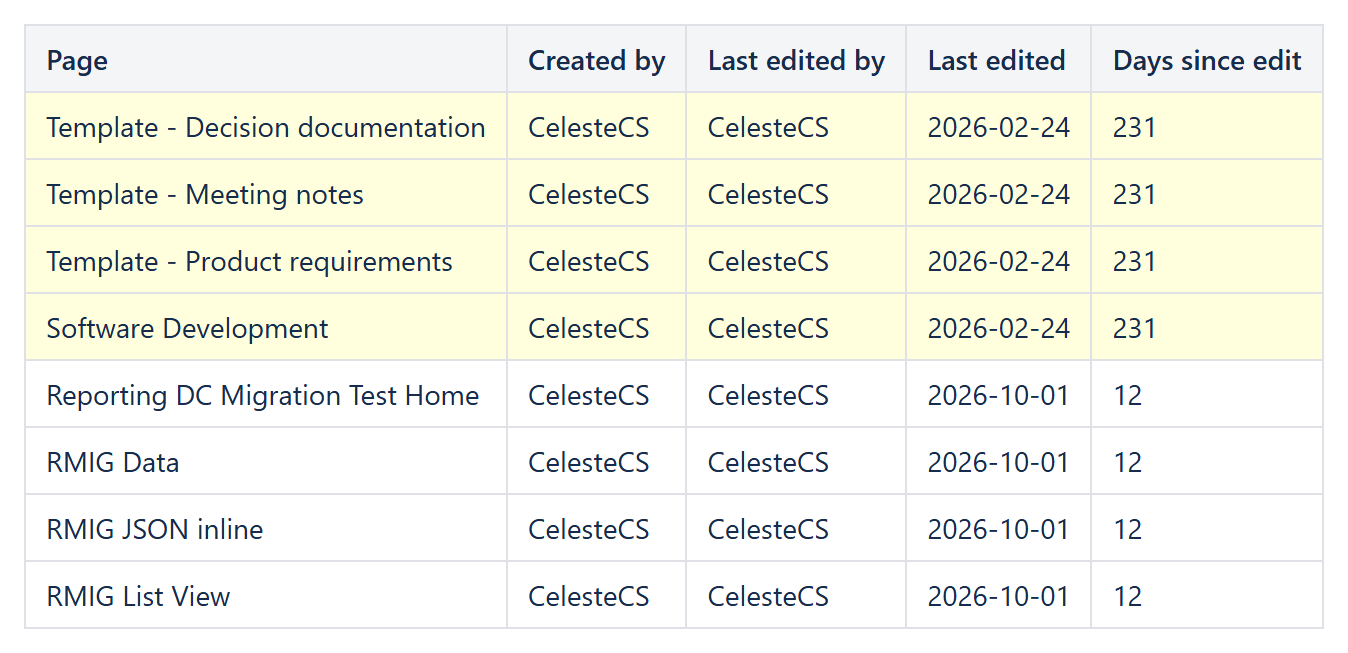
Example: Confluence pages returned by a CQL query, with creator, last editor and days since the last edit.
Reporting Confluence Data Provider macro has the following parameters:
| Parameter | Description |
|---|---|
| [String] Query (default=''(Empty value)) |
A CQL query to be used to search for Confluence items. This parameter cannot be empty. Examples:
New! The query may contain variables that are replaced with the current page's values before the query runs, so the same report placed in a page template works on every page created from it:
Put them inside quotes, e.g. 'label = "${page.title}" and space = "${space.key}"' - quotes inside the values are escaped automatically. |
| [String] Expand (default=''(Empty value)) |
A multi-value parameter indicating which properties of the content to expand. A good set of examples is specified here. Examples:
Known limitation On Confluence Server/Data Center, the creation and last-update dates exposed via 'history' ( |
| [String] Filter (default=''(Empty value)) |
The formula, which filters out the values when it returns False. Ignored if empty. A comparison that cannot be evaluated – a number against text, or an empty field – counts as False (since Reporting 14.1.0). Examples:
|
| [Long] Max results (default=1000) | The maximum amount of items to be returned. This feature is convenient to create the lists of TOP Something, when the items are sorted in CQL query and the amount is limited with this parameter. |
More examples
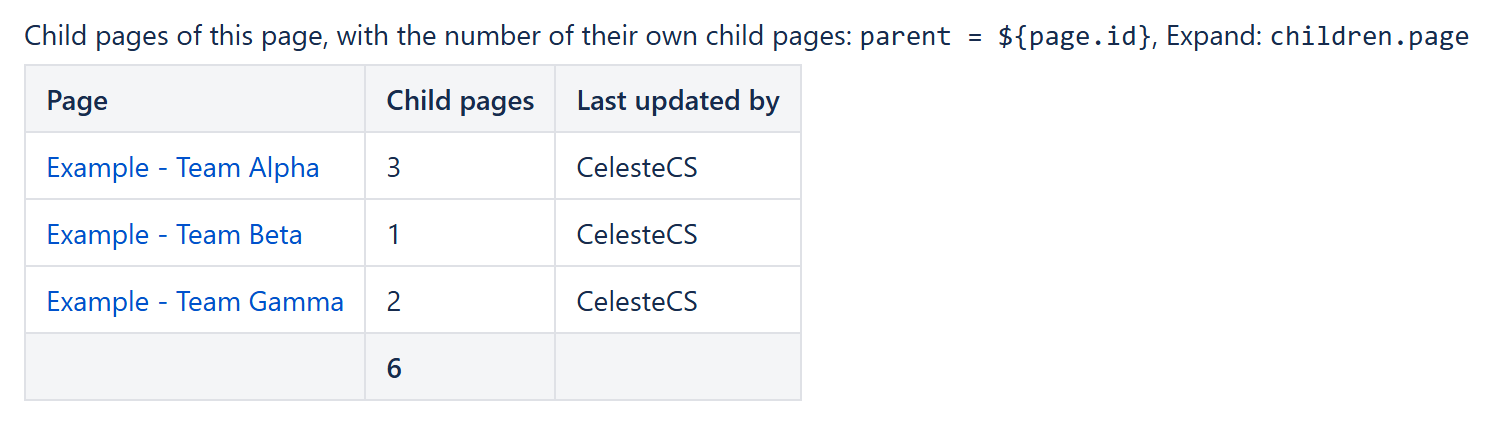
Example: Query parent = ${page.id} with Expand children.page lists the child pages of the current page and counts their own children with JSONARRAYLENGTH(CurrentItem.children.page.results).